
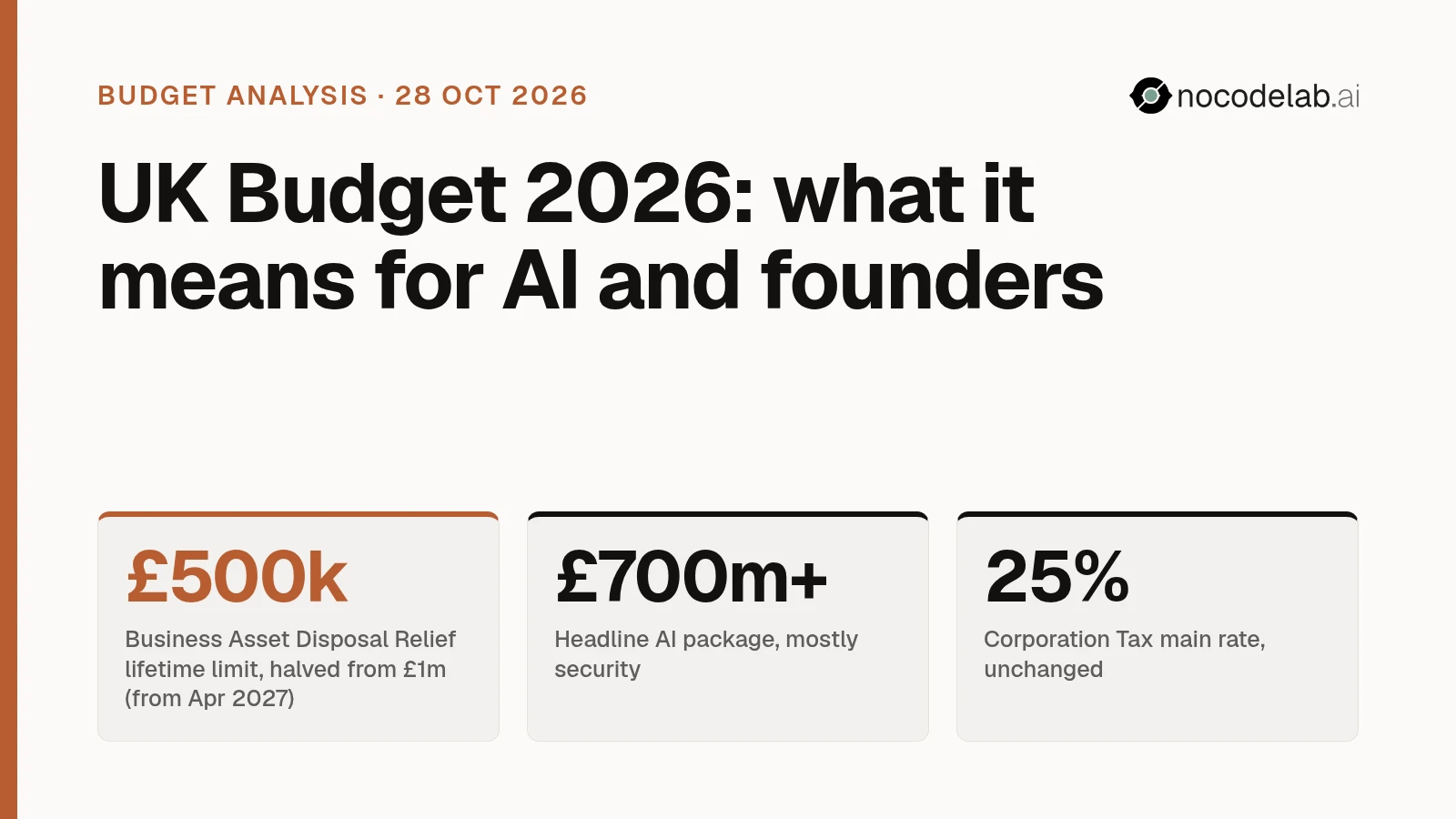
The Chancellor delivered Budget 2026 on 28 October 2026. The full document is Budget 2026: Breathing Space for Today, Fresh Hope for the Future (HC 726). We read the Red Book, the policy costings, HMRC's overview of tax changes and the supporting papers, so you don't have to. Here is what changes for UK founders, small businesses and anyone who trains people to use AI. We've also noted where the headlines and the small print don't quite match.
This is a summary, not tax or financial advice. Check the documents on GOV.UK, or talk to an adviser, before acting.
TL;DR
- Founders selling a business will pay more tax on exit. The lifetime limit for Business Asset Disposal Relief halves from £1m to £500,000 for disposals from 6 April 2027. The new 10% Founders' Relief covers up to £10m of gains, but only at companies with at least £10m turnover, 15 full-time staff and fast growth.
- The "over £700 million" AI package is real, but it is mostly about security. Around £480m goes to the AI Security Institute (£120m), AI biosecurity (£165m), cyber defence (£154m) and a new agentic security unit (£40m).
- Money to help small businesses adopt AI is small. There are local AI partnership pilots in three Yorkshire areas, worth £30m or £15m depending on which part of the Red Book you read.
- The public sector is buying AI: a £15m Chancellor's AI Challenge Prize (first round on the NHS, top award up to £2.5m), a £60m AI Pathfinder Fund, an extra £80m for Sovereign AI procurement, £35m for GovAI and a £50m Civil Service AI fund.
- The main business taxes don't change. Corporation Tax stays at 25% and 19%, employer NICs at 15%, the Employment Allowance at £10,500, the VAT threshold at £90,000, and dividend tax rates stay the same.
- Some useful start-up changes from 6 April 2027. The Trading Allowance triples to £3,000, the EMI2 option limit doubles to £120,000, and the R&D Claim Notification Form goes from 1 April 2027.
- VAT on overseas services is changing. From 1 April 2027, UK businesses that aren't VAT-registered will be charged UK VAT by overseas suppliers. The reverse charge will only apply to VAT-registered businesses.
What did the Budget announce for AI?
The Red Book promises "over £700 million" for AI (paragraph 4.128). Here is where it goes.
| Measure | What changes | Starts | Who it affects | Status | Red Book ref |
|---|---|---|---|---|---|
| AI Security Institute | Additional £120m for frontier AI testing and evaluation | 2026-27 to 2029-30 | AISI, frontier AI labs, AI assurance firms | New money | 4.130, 6.103 |
| National AI Biosecurity Initiative | £100m AI Biosecurity Lab (2027-28 to 2029-30), £50.5m for bio-surveillance and £14.5m for medical countermeasures, so £165m in total. OpenAI and Anthropic will provide up to £200m of AI model credits | 2027-28 | UKHSA, DSTL, life sciences | New money (credits are in kind) | 4.132, 6.108 |
| Cyber defence | £70m NERV Centre at the NCSC, £60m National Cyber Shield (including a £25m AI and Cyber Security Challenge Fund) and £24m for public-sector AI defence, so £154m in total | 2026-27 to 2029-30 | AI and cyber security firms, public bodies | New money | 4.131, 6.107, 6.109, 6.139 |
| National Agentic Security Unit | £40m to investigate and respond to rogue agentic AI incidents | Not stated | Government security, agentic AI developers | New money | 4.131, 6.106 |
| Sovereign AI Fund | Additional £60m on top of the existing £500m to invest directly in UK AI companies. New focus on physical and industrial AI | 2027-28 to 2029-30 | UK AI start-ups and scale-ups | New money | 4.135, 6.99 |
| Sovereign AI R&D Procurement Scheme | Additional £80m for challenge-led government procurement, including health and care, AI security, assurance and safe adoption | Not stated | AI companies selling to government | New money | 4.121, 6.105 |
| AI Pathfinder Fund | £60m for cross-government responses to barriers and opportunities from the AI transition | 2026-27 to 2029-30 | Government departments and their suppliers | New money | 4.135, 6.100 |
| Local AI partnerships | Pilots "starting with" West Yorkshire, South Yorkshire, and York and North Yorkshire, to help small businesses adopt AI, build skills and improve local services. £30m in 4.135, £15m in 6.101 | 2026-27 to 2029-30 | SMEs, councils and colleges in those areas | New money | 4.135, 6.101 |
| AI Economics Institute | Additional £23m for research into AI's effect on productivity, jobs and living standards | Not stated | Researchers, policymakers | New money | 4.135 |
| Chancellor's AI Challenge Prize | £15m annual competition run by DCMS. The first round focuses on the NHS, with a top award of up to £2.5m | 2026-27 to 2029-30 | UK AI innovators | New money | 2.18, 6.102 |
| AI hardware and chip design | £20m for AI hardware, including £18m for a UK Advanced Chip Design Academy led by the University of Edinburgh. Advance market commitment for British chips in public compute | October 2026 to March 2032 | Chip designers, universities | New money | 4.141, 6.87 |
| GovAI and Civil Service AI fund | £35m to set up GovAI, which gives civil servants frontier AI tools. £50m Civil Service AI transformation fund across 2027-28 and 2028-29, paid for by administrative savings | 2027-28 | Civil Service, AI suppliers and trainers | New money | 2.15, 6.6 |
| AI and Cyber Security Centre of Excellence, Manchester | New centre to develop cyber and AI security expertise. No figure given | Not stated | Cyber and AI security talent | New | 4.130, 6.110 |
| Data Centre Covenant | Tests that strategic data centres are expected to meet: paying a fair share of energy costs, a Local Benefit Plan, energy and water reporting, jobs and apprenticeships, and security. In return, a Ministerial Control Centre will speed up grid connections | Published 28 October 2026. Definitions "in due course" | Data centre developers, host communities | New policy | 4.137 to 4.139 |
| Data Centre National Policy Statement | Draft published for consultation | Now | Data centre developers | Consultation | 4.140 |
| Sovereign compute on the MoD estate | The MoD is "assessing" options, which "in time" could give UK SMEs secure compute | No date | SMEs needing compute | Exploring | 4.133 |
| Finance for AI hardware firms | Coordinated offer from public finance institutions and Sovereign AI | No date | UK AI hardware companies | Exploring | 4.142 |
| Cyber liability | Consultation next year on insecure technology and who is liable for cyber breaches | 2027 | Tech vendors and users | Consultation | 4.131 |
| AI Growth Zones | No new zones. The five existing zones continue | Existing | Host regions | Re-announced | p.74; Data Centre Covenant |
| Existing compute and Sovereign AI | £500m Sovereign AI Unit, up to 1m GPU hours on Isambard-AI and up to £750m for a national supercomputer in Edinburgh | Existing | AI start-ups, researchers | Re-announced | p.74 |
| NHS productivity and AI review | Independent review led by Mark Bailie | Reports early 2027 | NHS, health AI suppliers | Review | 2.17, 6.8 |
On regulation, the Entrepreneurship prospectus says a new Regulating for Growth Bill will give powers to change rules temporarily for trials. "AI Growth Labs" are named as a "potential use case" (prospectus paragraphs 2.14 to 2.16). There is no AI bill.
Is the £700 million AI package fact or hype?
Mostly fact, but you need to know where the money goes.
- The total roughly adds up. The named items come to about £767m, or more if you add GovAI's £35m. Most of it is spread over four years, 2026-27 to 2029-30, so the annual amounts are much smaller. The AISI's £120m works out at about £30m a year.
- The Treasury's own scorecard shows less. Table 6.1 lists £490m of AI spending across 2026-27 to 2031-32. Table 6.2 adds £160m of Sovereign AI financial transactions, making about £650m. The rest appears to come from existing budgets, but the documents don't reconcile the two totals.
- It is mostly about security. About £480m goes on security and resilience: AISI, biosecurity, cyber and the agentic security unit. The Red Book itself says "around £500 million" (4.129).
- The £200m from OpenAI and Anthropic is not public money. It is "up to" £200m of AI model credits, given in kind.
- Some figures differ between documents:
- The Sovereign AI R&D Procurement Scheme was £60m in the 24 October press release and is £80m in the Red Book.
- Chip design funding was £18m in the press release and in 6.87, against £20m for AI hardware overall in 4.141.
- The local AI partnerships are £30m in 4.135 but £15m in 6.101.
- The press release's £10m a year to study AI's impact on jobs does not appear as a line in the Red Book. The closest item is £23m for the AI Economics Institute.
- The productivity claim is an estimate. The OECD estimate that AI could add 0.4 to 1.3 percentage points a year to productivity growth is an outside projection (4.126). It is not a Treasury forecast.
What changes for founders, start-ups and SMEs?
| Measure | What changes | Starts | Who it affects | Status | Red Book ref |
|---|---|---|---|---|---|
| Business Asset Disposal Relief | Lifetime limit halved from £1m to £500,000. The rate on qualifying gains stays at 18%. Raises £60m in 2027-28, rising to £305m by 2031-32 | Disposals from 6 April 2027 | Owner-managers selling or winding up a business | Tax rise | 6.261 |
| Founders' Relief (new) | 10% CGT on up to £10m of lifetime gains. You must hold 25% from the start of trading, for at least 5 years, and have been UK resident for 5 years. The company needs £10m turnover and 15 full-time staff, and must pass 2 of 3 tests: 25% a year turnover growth, 25% a year headcount growth, or £1.5m of R&D spending. Your limit is reduced by any BADR or Investors' Relief claimed from 6 April 2027 | 6 April 2027. Consultation closes 30 November 2026 | Founders and early backers of high-growth companies | New relief | 4.97, 6.257 |
| EMI2 (the renamed CSOP) | Option limit doubles from £60,000 to £120,000. Exercise period rises from 10 to 15 years. The interaction with the EMI limit is removed, so staff can hold up to £370,000 across EMI (£250,000) and EMI2 | 6 April 2027 | Growing companies hiring and keeping talent | New | 4.99, 6.255 |
| EMI flexibility | Window to exercise after a disqualifying event rises from 90 to 180 days. EMI status is kept on a move to an Employee Ownership Trust. Grant notifications are scrapped | 6 April 2027 | Companies using EMI | New | 6.258, 6.260 |
| R&D tax relief admin | Claim Notification Form removed. Additional Information Form simplified. No rate changes | 1 April 2027; AIF changes from autumn 2027 | R&D claimants | Simplification | 6.253 |
| EIS, SEIS and VCT | Minor technical fixes only, plus guidance on excessive fees and a better Advance Assurance service. No change to limits or rates | Finance Bill 2026-27 | Start-ups raising angel or VCT money | Technical | 6.256 |
| Capital allowances | Main-rate first-year allowance rises from 40% to 50% (new plant only, not cars or second-hand assets). Main-rate writing-down allowance falls from 14% to 12%. Overall a tax rise of £765m in 2027-28 | 50% FYA from 1 January 2027. 12% WDA from 1 April 2027 (Corporation Tax) and 6 April 2027 (Income Tax) | Businesses investing in equipment | Mixed | 6.251 |
| Trading Allowance | Triples from £1,000 to £3,000 of tax-free trading or miscellaneous income | 6 April 2027 | Side hustles, new sole traders | Tax cut | 4.100, 6.254 |
| Distributions framework | Stops profits being extracted as capital gains through complex arrangements, such as a new holding company plus a share buyback. Purchase of own shares relief modernised. Dividend and CGT rates unchanged. Raises about £800m a year | Draft law in 2027, in force April 2028 | Shareholders who control how profits are paid out | Tax rise | 6.181 |
| Cross-border services VAT | The reverse charge will only apply to VAT-registered buyers. Overseas suppliers must charge UK VAT to UK businesses that aren't registered. Raises £70m to £75m a year | 1 April 2027 | Micro businesses below the VAT threshold that buy overseas services | Tax rise | 6.183 |
| Savings and property income | Tax rates rise by 2 percentage points. Dividend rates are unchanged | 6 April 2027 | Individuals with interest or rental income | Tax rise | Table 6.1 |
| Rates that stay the same | Corporation Tax 25% main rate and 19% small profits rate. Dividend tax 10.75%, 35.75% and 39.35%, with a £500 allowance. Employer NICs 15% above £96 a week. Employment Allowance £10,500. VAT registration threshold £90,000 (deregistration £88,000). Annual Investment Allowance £1m | 2027-28 | All businesses and employers | Unchanged | OOTLAR Annex A |
| British Business Bank | £5bn of extra capacity, taking the total to £30.6bn. Includes £1.4bn for equity funds and £450m for a new venture debt product. The Chancellor's letter expects up to £900m for defence and dual-use | From Budget | Venture-backed and scaling businesses | New | 4.46, 4.101 |
| Growth Guarantee Scheme | Expansion to support £6.5bn of additional SME lending | Already announced | SMEs borrowing from banks | Re-announced | 4.46 |
| Making Tax Digital for Income Tax | No penalty points for the first four quarterly updates in 2027-28 for those joining in April 2027. Roll-out deferred for several groups | April 2027 | Sole traders and landlords | Easement | 6.152 |
| E-invoicing | VAT invoices must be issued in a set electronic format | 1 April 2029 (full design by April 2028) | VAT-registered businesses | New requirement | 6.145 |
| Tax-free mileage rates | The 55p rate for the first 10,000 business miles becomes permanent. The rate above 10,000 miles rises from 25p to 35p | 35p from 6 April 2027 | Employees and self-employed people who drive for work | Tax cut | 3.14, 6.213 |
| Non-compete clauses | The government will legislate so non-competes don't hold back start-up hiring. Consultation "shortly" on wider restrictive practices | Position in early 2027 | Start-ups hiring, employees | Consultation | 4.109 to 4.111, 6.93 |
| Young Entrepreneurs Allowance | Pilot of living-cost support for the first year of a new business in England. No amount given | "Shortly" | Young founders | Pilot | 4.104, 6.126 |
| Scale UK – Connect | Regional pilot offering tailored support to 200 high-growth firms | Not stated | High-growth firms | Pilot | 4.105 |
| Pension money for start-ups | The Mansion House Accord "should unlock around £25bn". The government "will work with" the industry. No new measure | Ongoing | VC funds, scale-ups | Re-announced | 4.102 |
| Stamp taxes on shares | Securities Transfer Tax replaces stamp duty and SDRT. A cut is only "kept under review" | Late 2027 | Share buyers | Re-announced | 4.103, 6.179 |
| Public procurement | New "UK supplier" definition by January 2027. National Procurement Policy Statement in March 2027 | January to March 2027 | SMEs bidding for public contracts | New | 4.115 to 4.120 |
| Innovation clusters and spin-outs | £1bn over four years with UKRI for priority clusters. £25m for Venture Doctorates. Up to £16m for proof-of-concept funding | Over four years | Universities, spin-outs | New | Prospectus |
What does this mean for small AI training and consultancy firms?
- Exits. Most owner-managed service businesses will lose more from the Business Asset Disposal Relief cut than they gain from Founders' Relief. To qualify for Founders' Relief, a company needs £10m turnover, 15 full-time staff and either 25% annual growth or significant R&D.
- Overseas services. From 1 April 2027, small businesses below the £90,000 VAT threshold will be charged UK VAT by overseas suppliers and can't reclaim it. The documents don't list which services are affected, so check how your software, AI tools and advertising platforms are billed.
- Digital services and advertising. We found no change to the Digital Services Tax and no measures on online advertising.
- Training costs. We found no new tax relief for employer-funded training and no change to the Growth and Skills Levy.
- Kit. The 50% first-year allowance applies to new plant bought from 1 January 2027. Most small firms will still claim 100% through the £1m Annual Investment Allowance.
- Business rates. The new reliefs are aimed at retail, hospitality and leisure. Office-based firms gain only from the abolition of the £150 and £300 Valuation Tribunal appeal fees (6.194).
What changes for skills, apprenticeships and visas?
| Measure | What changes | Starts | Who it affects | Status | Red Book ref |
|---|---|---|---|---|---|
| High Potential Individual visa | Opened to graduates of the world's top 150 institutions, with a proportional increase to the cap | Not stated | Employers hiring recent top graduates | New | 4.112, 6.96 |
| Graduate visa | Two years for graduates of high-compliance universities | Not stated | International graduates, employers | New | 4.112 |
| Visa salary thresholds | Occupation-specific thresholds move from the median to the 25th percentile of wages. The PhD discount is removed | Spring 2027 | Sponsoring employers | New | 6.94 |
| Global Talent visa | UKRI to identify more R&D-intensive host businesses for the endorsed funder route | By spring 2027 | R&D-intensive firms | In progress | 6.132 |
| Immigration Skills Charge | When an employer pays the charge or the Certificate of Sponsorship fee, it is no longer a taxable benefit in kind | Payments from 28 October 2026 | Sponsoring employers | New | 6.15 |
| Mayoral apprenticeship services | £100m over 2027-28 and 2028-29 to expand apprenticeship brokerage from 7 to 14 Mayoral Strategic Authorities | 2027-28 | SMEs taking on apprentices | New money | 6.125 |
| Youth Jobs Grant and apprentice hiring payment | £3,000 Youth Jobs Grant. £2,000 payment for non-levy employers hiring young apprentices | Already announced | Employers hiring young people | Re-announced | p.93 |
| Union Learning Fund | Re-established in England with £15m a year | From 2027-28 | Workers in unionised workplaces | New money | 6.127 |
| National Living Wage | Rises 3.9% to £13.21 an hour. 18 to 20-year-olds £11.27. 16 to 17-year-olds and eligible apprentices £8.31 | 1 April 2027 | All employers | Change | 6.128 |
| Women in tech | Voluntary Tech Forward and Inclusive Investment Standards. A scale-up programme for women founders. A British Business Bank pipeline of over £100m for women-led funds | Not stated | Women founders, fund managers | New | 4.106, 4.107 |
The Budget has no national AI skills programme for the workforce and no new funding for SMEs to train staff in AI. The Red Book doesn't mention the Growth and Skills Levy.
What's missing from Budget 2026?
- Ordinary owner-managers lose out on exit. The Business Asset Disposal Relief limit is halved, while the generous Founders' Relief is limited to fast-growing companies with £10m turnover.
- No national incentive for SMEs to adopt AI. There are no grants, tax credits or vouchers. The only support is the pilots in three Yorkshire areas.
- No money to build workforce AI skills. There is no relief for employers' training costs and no reform of the skills levy.
- No relief on employment costs. Employer NICs stay at 15% with the threshold at £96 a week. The VAT registration threshold stays frozen at £90,000.
- Lower allowances on equipment. Cutting the writing-down allowance to 12% offsets the higher first-year allowance and raises about £1bn a year overall.
- Only admin changes for R&D relief and EIS, SEIS and VCT. No new limits or rates.
- No new AI infrastructure or regulation. There are no new AI Growth Zones, no new public compute funding and no AI bill.
- Several measures have no figure or date yet. These include the Young Entrepreneurs Allowance, the definition of "strategic data centres" and the Regulating for Growth Bill.
Key dates
- 28 October 2026: Budget published. Employers' Immigration Skills Charge payments stop being a taxable benefit.
- 30 November 2026: Founders' Relief technical consultation closes.
- 1 January 2027: 50% main-rate first-year allowance starts.
- January 2027: New "UK supplier" definition for public procurement.
- Early 2027: NHS productivity and AI review reports. Government sets out its position on non-compete clauses.
- March 2027: National Procurement Policy Statement.
- Spring 2027: Visa salary thresholds move to the 25th percentile. More Global Talent host businesses identified.
- 1 April 2027: Cross-border services VAT change. R&D Claim Notification Form removed. 12% writing-down allowance for companies. National Living Wage rises to £13.21.
- 6 April 2027: BADR limit cut to £500,000. Founders' Relief, EMI2 and the EMI changes start. Trading Allowance rises to £3,000. Savings and property income tax rises by 2 points. 35p higher mileage rate.
- Autumn 2027: Simpler R&D Additional Information Form.
- Late 2027: Securities Transfer Tax replaces stamp duty on shares.
- April 2028: Distributions framework changes take effect, with draft law in 2027.
- 1 April 2029: Mandatory e-invoicing for VAT.
FAQ
Is the £700 million for AI new money?
Mostly, yes, but it is spread over about four years and around two-thirds of it is for security and resilience. The Treasury's scorecard shows about £650m of new spending and financial transactions. The £200m from OpenAI and Anthropic is AI model credits, not public money.
What is Founders' Relief, and will my business qualify?
It is a new 10% Capital Gains Tax rate on up to £10m of lifetime gains, starting on 6 April 2027. The company needs at least £10m turnover and 15 full-time staff, and must pass two of three growth or R&D tests. Most small service businesses will not qualify. The consultation closes on 30 November 2026.
What happens to Business Asset Disposal Relief?
The lifetime limit halves from £1m to £500,000 for disposals from 6 April 2027. Qualifying gains are still taxed at 18%.
Is there any new funding for AI training or skills?
There is no national scheme. The closest measures are the local AI partnership pilots in Yorkshire, the £15m-a-year Union Learning Fund, GovAI and the Civil Service AI fund for civil servants, and £18m for a chip design academy.
Did Corporation Tax, NICs or the VAT threshold change?
No. Corporation Tax stays at 25% (19% small profits rate), employer NICs at 15%, the Employment Allowance at £10,500 and the VAT registration threshold at £90,000. Dividend tax rates are also unchanged.
Sources
All documents were published on GOV.UK on 28 October 2026 unless stated. Red Book references above are paragraph numbers; page numbers are the printed pages.
- Budget 2026 (Red Book), PDF. Key paragraphs: AI package 4.126 to 4.142 and 6.99 to 6.112; founders 4.97 to 4.113; tax measures 6.251 to 6.261, 6.181 and 6.183; skills 6.125 to 6.128; GovAI 2.15; NHS review 2.17; AI Challenge Prize 2.18.
- Budget 2026 document page
- Supporting documents: policy costings and Tables 6.1 and 6.2
- Policy costings, PDF
- Overview of Tax Legislation and Rates (OOTLAR) and Annex A: rates and allowances
- Entrepreneurship in the UK: Start. Scale. Stay.
- Founders' Relief: technical consultation
- Tax Support for Entrepreneurs: call for evidence and response
- Government letter to the British Business Bank
- Data Centre Covenant
- Modernising the distributions framework
- HM Treasury: Budget 2026: Breathing space for today, hope for the future
- HM Treasury: Chancellor unveils Britain's ambitious plan for AI (24 October 2026)
- Budget 2026 in full (collection)
A note on this article. This article was created with AI assistance and it might make mistakes. Please check all sources, especially the GOV.UK documents linked above, before relying on any figure, date or rule.
Want to talk through what this means for your business? Book a free 30-minute call. No pitch, just an honest read on where you stand.