There’s a moment most solo founders know well. You’re sitting alone, staring at the same four walls, trying to will your idea into existence through sheer determination. Caroline Stevenson knows that feeling intimately. As she puts it: “There’s only so long you can sit and stare at a magnolia wall and try to have a conversation with it. Go out and have conversations with other people instead, and learn things.”
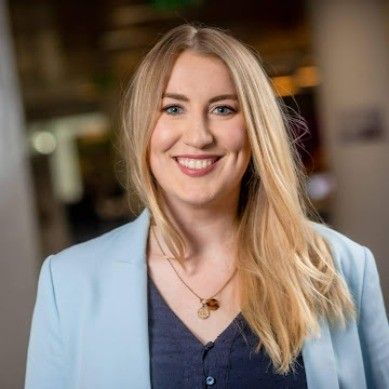
It’s a line that captures something every entrepreneur eventually confronts - the isolation, the self-doubt, the creeping suspicion that talking to yourself isn’t a viable business strategy. For Caroline, the magnolia wall wasn’t just a metaphor. It was the reality of being a non-technical founder with a validated idea, no funding to build it, and nowhere left to turn.
From Hundreds of Thousands of Meals to a Mental Health Mission
Caroline’s journey didn’t start with a therapy platform. In 2015 she launched Foodinate, a social enterprise tackling food poverty in the UK through a meal-for-meal model with restaurants and event venues. Over the following years she scaled it nationally across 14 cities, generating hundreds of thousands of meals for people in need, picking up 16 awards and national press coverage along the way.
Then COVID hit. Hospitality - the backbone of Foodinate - shut down overnight, and so did what Caroline had spent years building. During the crisis, Caroline found herself struggling with her own mental health, and discovered first-hand how difficult it was to find the right therapist. Not just someone qualified, but someone whose personality actually fits.
“What I really struggled with was finding that person who you get along with, that you can build that trusted rapport with,” she explains. “There’s actually decades of research showing that the personality fit between therapist and client is one of the most consistent determinants of how successful the outcomes of therapy will be. But I couldn’t find anything taking that factor into account.”
That gap became MindFolk - a platform designed to match people with therapists based on genuine personality compatibility, not just availability and qualifications.
The Catch-22 That Nearly Killed the Big Idea
Caroline secured Innovate UK funding to validate the concept. She surveyed 300 therapists and therapy seekers, ran two rounds of prototyping, and emerged with powerful numbers: around 80% concept validation, 94% feature validation, and 82% willingness-to-pay validation - all before writing a single line of code.
It should have been enough. It wasn’t.
Every early-stage funding programme she approached - pre-seed investors, accelerators, venture programmes - gave her the same feedback: “This is amazing. This is the kind of thing we want to invest in. Love everything you’ve done so far… but you need to have an MVP first.”
The classic catch-22. You need money to build the product. You need the product to get money. And as a non-technical founder without deep pockets, Caroline found herself stuck. The momentum that had carried her through had ground to a halt.
A Light Bulb Moment
When Jess at Praetura Ventures connected Caroline with the team at NoCodeLab.ai, she was cautiously hopeful at best. She’d looked into no-code platforms before and written them off. Mostly because MindFolk wasn’t a simple landing page. It was essentially two interconnected apps (one for therapists, one for clients) in a regulated health industry dealing with vulnerable people.
“My hopes were very high and my expectations were, in honesty, low,” she says. “I kind of went into it with an open mind. But I was blown away with what you can do, and how far the technologies had moved on.”
What made the difference wasn’t just the tools Caroline tried, tested and ultimately used during the NoCodeLab Launchpad Accelerator - it was the structure and the support system around her. The Accelerator gave Caroline a cohort to learn alongside, a safe space to ask questions (she cheerfully admits to being “number one question asker”), and a community of previous cohorts through the WhatsApp group who’d been exactly where she was.
“You kind of go into the programme for the knowledge and skills, but actually you come out with much more,” she reflects. “You come out with those connections and that support network that’s completely non-judgmental… it is a really powerful thing.”
Running Through the Wall
Caroline describes her time on the Accelerator with an image that’s hard to forget: “I felt like I’d been running at a brick wall for so long, and then finally a door had appeared in the wall, and I was just - wheeeeeee! - running through it as fast as I could.”
That energy took her from a standing start to a tangible, demonstrable product. Not the polished, production-ready platform she’ll eventually need - she’s honest about the fact that a regulated health product working with vulnerable people will require professional development to get over the finish line. But the Accelerator got her to what she estimates is 80–85% of the way there, dramatically reducing the blocker for any developer or technical co-founder she brings on board.
More importantly, it changed the conversations she could have. She now speaks with developers from a position of greater technical understanding, can walk them through what she’s built, and can articulate what she needs.
What Happens When You Leave the Magnolia Wall Behind
Asked what she’d say to someone sitting on a great idea, unsure what to do next, Caroline doesn’t hesitate.
“The skills you can learn in such a short amount of time can get you so much further than you probably ever would expect to be able to get on your own. And you get to do it not on your own - you get to join a cohort of people learning alongside you, and a broader community of people who’ve been where you are.”
For some projects - internal tools, simpler applications - no-code can take you 100% of the way to a fully deployed product. For more complex builds like Caroline’s, it eliminates the vast majority of the initial blocker and turns a seemingly impossible mountain into a manageable last mile.
What’s Next for Mind Folk
Caroline is now ready for the next chapter. With a validated concept, a working prototype, and hard-won technical understanding, she’s looking for a CTO or technical co-founder to help take Mind Folk from 85% to a fully deployed, production-ready platform. It’s a rare opportunity to come on board at the ground floor of a mission-driven venture in digital mental health - with the research, the validation, and the product vision already in place.
If that sounds like you, or someone you know, get in touch with us at NoCodeLab.ai and we’ll connect you with Caroline directly - info@mindfolktherapy.com.
But perhaps the most important thing Caroline gained wasn’t technical at all. It was the realisation that she didn’t have to figure it out alone. That the wall she’d been staring at for so long wasn’t as solid as it looked - she just needed the right people around her to find the way through.
Somewhere right now, there’s a founder staring at their own magnolia wall, wondering if their idea will ever become real. Caroline’s story is proof that it can. You just have to be willing to leave the room.
Ready to stop staring at the wall?
Join our next Launchpad Accelerator cohort at nocodelab.ai